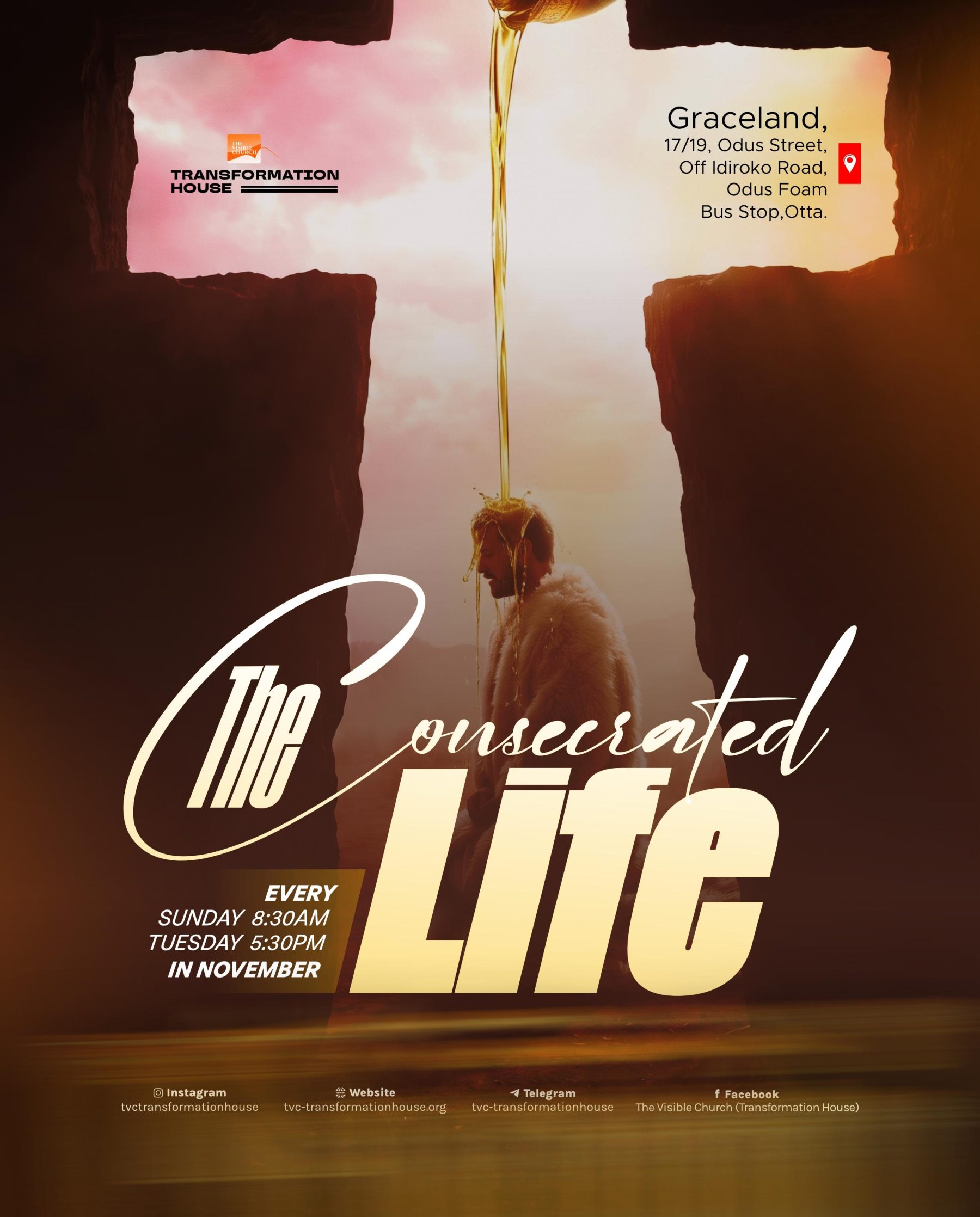
THE CONSECRATED LIFE
2 Corinthians 5:14-15KJV “For the love of Christ constraineth us; because we thus judge, that if one died for all, then were all dead:and that he died for all, that they which live should not henceforth live unto themselves, but unto him which died for them, and rose again.”
This is the highlight of that scripture for us: those who live as a result of the fact that One died for us, those of us who have benefited from His death, whose redemption and rescue from the power of sin and Satan were bought by His death.
Someone stood in our place; someone died for us so that we might live. Scripture says that henceforth from the very moment anyone comes under the influence of the power of redemption and the transforming power of God that set us free, we can no longer live for ourselves.
The moment you come into the realization and understanding of the benefits and privileges of His death, you reach a turning point. From that point of awareness and consciousness of the power of God that delivered you, you recognize: "My life is dependent on the sacrifice of Someone." Because He died for all that we might live, henceforth, from that point of understanding, you do not live for yourself; you live for the One who died for you and rose again.
The realization that Someone took our place and died on our behalf must bring us to a place of responsibility. The death and sacrifice of Jesus make a divine demand upon our lives.
To understand this foundation, there are two key components:
The Redemption of Christ bring us to a place where we acknowledge the Ownership of God over our life.
The power of redemption brings us to a position where we acknowledge and submit to God's complete ownership.
Something happened on our behalf: Someone died for us, delivered us, and liberated us. Now, some people who do not fully understand the reality of redemption assume: "He delivered us, He liberated us, so we have total freedom to do whatever we want in Christ."
That is a very good place to start, but a bad place to stop, It is true that Christ died on your behalf and liberated you. You enjoy freedom in Christ, and no one is permitted to take that liberty away from you. But there is another dimension, now that we have enjoyed that deliverance and have been rescued from the sentence of sin and death, Scripture says henceforth, anyone who understands this cannot live for himself. If He died for you and liberated you, you live for the One who gave you that liberty.
In spiritual freedom, you are not free to self-govern. You are a free man who is bound to Christ. The lack of this understanding causes many to live carelessly. They argue, "I have liberty in Christ; I am delivered” They are correct about their deliverance, but they left the class before the lesson was finished, It is one thing to attend a class, grab only a portion of the course, and assume you know everything, until the exam appears and reveals what you missed.
Let us be clear, no one is contesting your deliverance or your liberty, the penalty of sin and death has been removed, Jesus conquered, You are free from the penalty and consequences of sin, and no charge can be brought against you. But in that freedom, you are not free to be your own master.
2Corinthians 5:15 KJV “And that he died for all, that they which live should not henceforth live unto themselves, but unto him which died for them, and rose again.”
It is an issue of Redemption and God's Ownership. You can be grounded in the reality of redemption, yet fail to submit to the ownership of God.
Consecration is not the basis or condition for salvation. You are saved first; that is why you consecrate your life. You cannot tell a person dead in sins and trespasses to consecrate himself, that would be an abnormality. Consecration is for those who have come to the saving knowledge of His grace and enjoyed the benefits of redemption
2 Corinthians 5:14 "For the love of Christ constraineth us..."
The love of God is endless, undying, and unmeasurable. There is nothing you can do to undo or diminish God's love for you. However, when you truly understand this love, it brings you under subjection. The phrase "constraineth us" means to compel, motivate, govern, and control.
While an ungrounded person might misuse God's unending love as an excuse to live recklessly, Apostle Paul declares that the very love of God is what controls and restrains him. Paul says: "Because I know how much He loves me, that same love controls me."
Romans 12:1-2KJV “I beseech you therefore, brethren, by the mercies of God, that ye present your bodies a living sacrifice, holy, acceptable unto God, which is your reasonable service. And be not conformed to this world: but be ye transformed by the renewing of your mind, that ye may prove what is that good, and acceptable, and perfect, will of God.”
Notice how the demand to live a life of total devotion to God comes as an appeal based on His mercy: "I beseech you therefore, brethren, by the mercies of God..."
When you think of what He has done for you, how He loved you, took your place, and died for you is it too much to ask that you present your body as a living sacrifice?
Living a consecrated life is not a condition to gain God's love, it is your natural response to the love and mercy you have already received. When you grasp the magnitude of His mercies and the weight of Jesus' sacrifice, living for Him will never feel like an unreasonable demand. Anyone who understands the weight of the cross responds by offering his life back to God.
Our response to the grace of God must never be a license for sin or reckless living. If you are truly grounded in the love and mercy of God, your response will be: "Lord, I give my life to You. Henceforth, I cannot live for myself." If the foundation of love is missing, any attempt to live a consecrated life will feel like forced compulsion.
The life of consecration is not a demand from God, it is our response to how much he loves us.
Consecration is not church law or the fear of judgment. If what initially motivated you to come to Christ was the fear of hellfire, that might have been a fair place to start, but it is a very bad place to stay. We do not serve Jesus out of fear of hell or rules and regulations. As you grow in the knowledge of God's Word, the grace, love, mercy, and sacrifice of Jesus become so real to you that you serve Him out of deep personal devotion.You do not serve Jesus because your father is a pastor or because someone forced you. You serve Him because you understand the weight of His sacrifice.
The love of Christ becomes your driver and your motivation.When the love of God grips your heart, you lose all fear of men and consequences. The only thing that holds your heart is Jesus and His sacrifice. You realize that it was not the physical iron nails that held Jesus to the cross; it was love that held Him there.
It was you and I that kept Him on the cross. When they came to arrest Him in their midst, they all fell to the ground at His word. Jesus declared that no man could take His life from Him. He had the power to lay it down voluntarily. It was not soldiers who captured Him; love captured Him.
When you come to that revelation and understanding, you step out of mere religious activity and jump into the love of Christ25. Serving God ceases to be about routine or compulsion, it is no longer about social connections, business networking, or seeking material gains.Can we come to a place where our sole motivation for serving Jesus is the revelation of His love, His mercy, and the weight of His sacrifice.
Redemption introduces us to God's ownership. Throughout scripture, Paul refers to himself as a bondservant, a slave of righteousness, and a prisoner of Jesus Christ. All these terms point to one reality: he no longer owned himself. The reason why you won't do certain things as a believer should no longer be whether it is a sin or not, it should be because of your love for God.
In the Old Testament, the Hebrew root word for consecrate is to set apart, dedicate, or sanctify for God's sacred use. In the New Testament, the Greek equivalent is Hagiazō which likewise signifies being separated unto God.
Consecration is moving from the common floor to the holy altar. When an object was placed on the altar in the Old Testament, it became set apart exclusively for God's use and everybody will regard that object as the presence of God because it is sanctified. Sanctified also means consecrated.
In the New testament, consecration is belonging to God, being set apart for God, and surrendering your entire person to God. It is your voluntary response to God's mercy, grace, and love. It is not God that consecrates men in the new testament, it is men after understanding the revelation of the love of God, the mercies of God, the weight of his sacrifices, surrender their life to God totally.
What is Consecration
Belonging to God
Being set apart for God
Surrender of the whole person to God
A response to God's love, mercy, and grace and our deep understanding of the weight of his sacrifice on the cross.
Consecration requires separation without isolation.
We are called to be separated from the ways of the world, not isolated from society. We live in this world, but we are not of this world.
John 17:15-16 KJV “I pray not that thou shouldest take them out of the world, but that thou shouldest keep them from the evil. They are not of the world, even as I am not of the world.”
Separation means there is a clear demarcation in your values, conversation, conduct, and choices. People should easily recognize your identity as a believer through your virtue, your words, and your stance for righteousness. Standing for Jesus may sometimes cost you temporary convenience or worldly privileges, but in the light of eternity, those temporary compromises mean nothing compared to standing uncompromised with Christ.
1Corinthians 6:19-20 KJV “What? know ye not that your body is the temple of the Holy Ghost which is in you, which ye have of God, and ye are not your own? For ye are bought with a price: therefore glorify God in your body, and in your spirit, which are God's.”
You are not your own, God's stamp of ownership is upon your life. You were bought with an expensive price, the precious blood of Jesus. Because He bought you, He instructs: "Therefore glorify God in your body, and in your spirit, which are God's."
Living carelessly or using your body dishonorably is a declaration of ingratitude toward the sacrifice of Jesus. You do not own this body or the breath in your nostrils; everything belongs to Him.
Titus 2:11-12 KJV “For the grace of God that bringeth salvation hath appeared to all men, Teaching us that, denying ungodliness and worldly lusts, we should live soberly, righteously, and godly, in this present world;”
The very grace that brings salvation is also our teacher. It teaches and empowers us to say "No" to ungodliness and worldly lusts, instructing us to live soberly, righteously, and godly in this present age.
Consecration is a life of sobriety and devotion. No pastor, leader, or human authority died for your redemption. Jesus alone paid the expensive purchase price with tears of blood.
Therefore, our standard of living must be aligned with the One who bought us.
Throughout the Scriptures, the plan of redemption and the total surrender of Christ are clearly documented. On the Purity of God and Christ's Burden
Habakkuk 1:13 KJV 3 Thou art of purer eyes than to behold evil, and canst not look on iniquity: wherefore lookest thou upon them that deal treacherously, and holdest thy tongue when the wicked devoureth the man that is more righteous than he?
Psalm 16:10, Psalm 34:20, Psalm 40:7 Micah 7:19, Psalm 103:12, John 3:14, John 7:38.
In conclusion, let us reflect on the words of the classic consecration hymn by Frances Ridley Havergal:
Take my life, and let it be
Consecrated, Lord, to Thee.
Take my moments and my days;
Let them flow in ceaseless praise.
Take my hands, and let them move
At the impulse of Thy love.
Take my feet, and let them be
Swift and beautiful for Thee.
Take my voice, and let me sing
Always, only, for my King.
Take my lips, and let them be
Filled with messages from Thee.
Take my silver and my gold;
Not a mite would I withhold.
Take my intellect, and use
Every power as Thou shalt choose.
Take my will, and make it Thine;
It shall be no longer mine.
Take my heart, it is Thine own;
It shall be Thy royal throne.
Take my love; my Lord, I pour
At Thy feet its treasure-store.
Take myself, and I will be
Ever, only, all for Thee