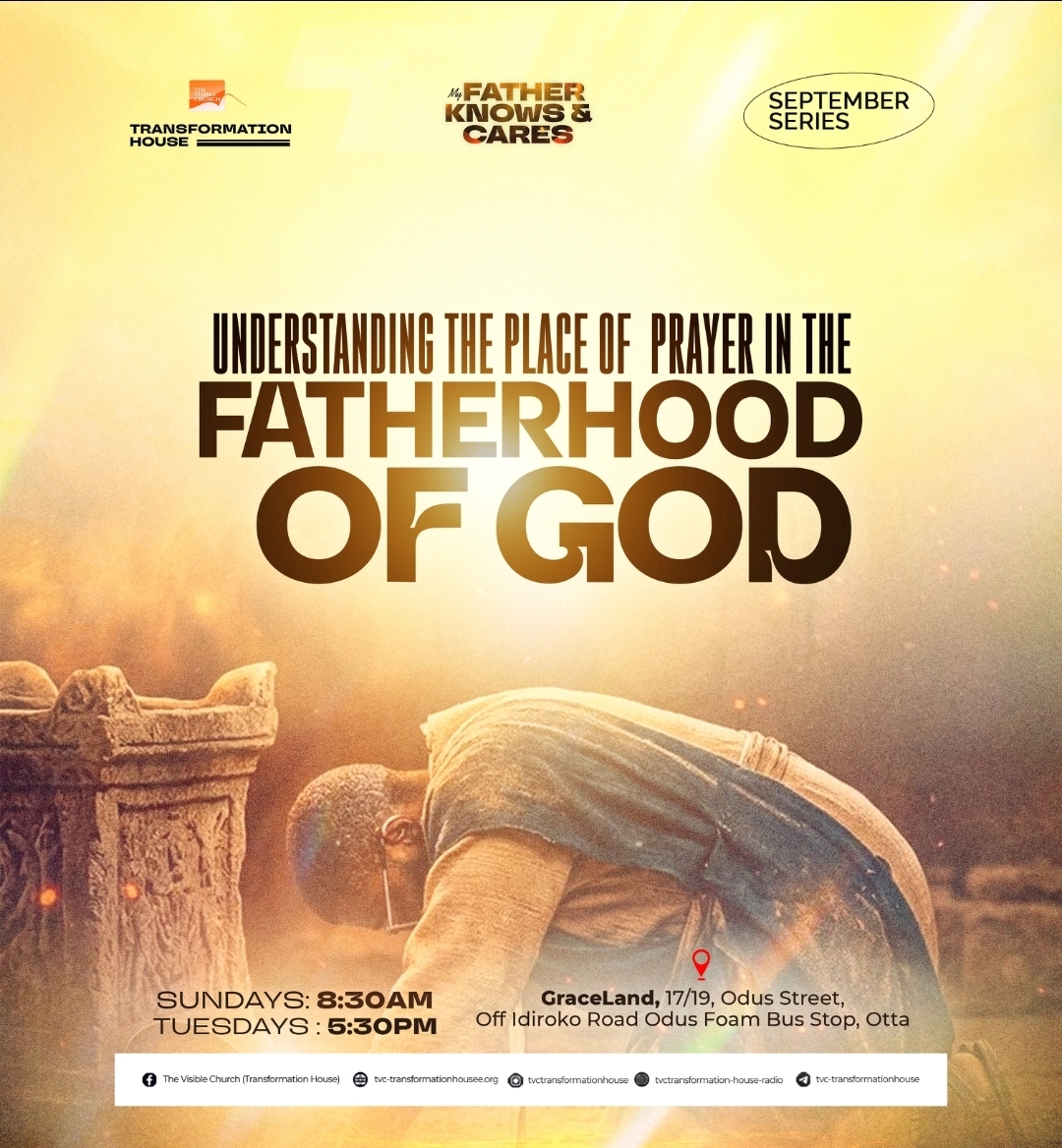
CASTING ALL YOUR CARES

The Principle of Casting vs. Carrying
God is completely able, and that is precisely why He asks you to cast your burdens upon Him. You are not permitted to carry your own burdens, your cares, or your tears. Your heavenly Father knows your situation, cares for you deeply, and possesses everything required to carry your burdens and wipe away your tears. Because He cares for you, you have no divine authorization to carry those heavy loads yourself. Scripture instructs us not to hold onto what God alone has the power and capacity to sustain.
Therefore, you must not carry tomorrow, nor carry the opinions of others, nor carry every fear or unanswered question. Whatever belongs in God's hands, and whatever you have placed in His care, you are forbidden from carrying any longer. If you have cast it, you must stop carrying it.
1 Peter 5:7 (KJV): "Casting all your care upon him; for he careth for you."
Psalm 55:22 (KJV): "Cast thy burden upon the LORD, and he shall sustain thee: he shall never suffer the righteous to be moved."
Many people suffer from high blood pressure and medical complications because they carry loads that were never meant for them. They visit hospitals, receive diagnoses, and take medications for conditions that stem primarily from internalizing unbearable weights. When you learn to drop your loads at the feet of the Lord, your entire posture changes. To the outside world, you may appear nonchalant or careless about life, but it is simply that you have learned the spiritual art of leaving your burdens at His feet.
Once you have dropped a burden, you should no longer look or act as though you are still carrying it. Casting and carrying are mutually exclusive concepts—they do not stand together. You must cast that burden upon the Lord.
Consider the illustration of planting corn in the soil: when a farmer plants corn, he does not dig it up every morning to inspect its progress, nor does he pull up a stool to sit over the soil anxiously wondering how it will grow. If you plant the seed, you must walk away and trust the system that God has put in place. In the very same way, when you cast your burden upon God in prayer, you must walk away and trust Him to bring forth the harvest in His timing.
Chapter 1: Seeking the Father Beyond His Gifts
As believers, we seek the Father not merely for the gifts He can bestow, but because He is our Father. Our primary understanding must be grounded in the reality of His fatherhood. Having God as our Father assures us that He is more than capable of caring for us. He explicitly invites us to cast our cares and worries upon Him.
Matthew 6:33 (KJV): "But seek ye first the kingdom of God, and his righteousness; and all these things shall be added unto you."
A mature believer does not constantly approach God with a transactional "Father, give me" mindset; rather, the mature believer learns to say, "Father, I want You." The greatest gift is not what comes from God's hand, but God Himself.
Psalm 73:25 (KJV): "Whom have I in heaven but thee? and there is none upon earth that I desire beside thee."
When a person reaches this spiritual conviction, he concludes that God Himself is his portion and ultimate desire.
Chapter 2: The Place and Fourfold Nature of Prayer
How exactly do we cast our cares upon the Lord? The primary venue where we cast our burdens and worries is in the place of prayer. Even though God is all-knowing and His knowledge precedes our prayers, prayer remains vital. God already knows what is in your heart before you speak, yet Jesus specifically instructed His disciples to pray.
When Jesus taught them to pray, He began with the foundation: "Our Father." A functional understanding of the fatherhood of God transforms your prayer life. Without this foundation, you will pray out of anxiety and fear. But when you understand that the God of heaven and earth is your Father, a holy boldness fills your requests—just as a child asks a wealthy parent with total confidence in their capacity. You don’t pray like an orphan, nor do you pray to a Father who is destitute or constrained by scarcity. All power belongs to Him.
Prayer goes beyond merely asking for things; true prayer encompasses four essential dimensions:
Fellowship: Prayer is intimate communion and fellowship with the Father.
Dependence: Prayer is an expression of complete reliance on the Father.
Alignment: Prayer brings our desires into alignment with the will of the Father.
Participation: Prayer allows us to participate in divine purpose and administration.
Matthew 7:7 (KJV): "Ask, and it shall be given to you; seek, and ye shall find; knock, and it shall be opened unto you:"
When we bring our requests to the Lord in prayer, we lay down our burdens. The true acid test of whether you have prayed through on a matter is not an immediate emotional breakthrough or an instant answer; it is the presence of the supernatural peace of God in your soul. Even when deadlines approach rapidly and circumstances remain unresolved, your soul remains undisturbed and calm because you have anchored yourself in His peace.
Consider the infinite capacity of our almighty God: billions of people across different locations, speaking different languages—Spanish, French, or indigenous African dialects—can pray simultaneously, and God is never overwhelmed or confused. He listens to every detail without mixing up one person's needs with another's. Pause and reflect on His majestic greatness.
Chapter 3: Trusting God Beyond Human Intelligence
While we pray, we must actively trust the Lord. Trust represents divine wisdom that operates beyond human understanding.
Proverbs 3:5–6 (KJV): "Trust in the LORD with all thine heart; and lean not unto thine own understanding. In all thy ways acknowledge him, and he shall direct thy paths."
God does not disapprove of human intellect, education, or analytical ability. He knows you have gone to school, mastered metrics, and understood complex calculations. However, Scripture explicitly commands us not to lean on our own understanding. Having information and intelligence is necessary, but placing your ultimate confidence and security in human analysis will limit you.
Psalm 20:7 (KJV): "Some trust in chariots, and some in horses: but we will remember the name of the LORD our God."
Proverbs 18:10 (KJV): "The name of the LORD is a strong tower: the righteous runneth into it, and is safe."
Job 32:8 (KJV): "But there is a spirit in man: and the inspiration of the Almighty giveth them understanding."
Even when financial metrics, business proposals, or economic forecasts appear lucrative on paper, the believer possesses a spiritual advantage through the Holy Spirit—often described as spiritual discernment. The Spirit of God can warn you that a proposal has no future, delivering you from loss before you commit your resources.
Chapter 4: The Discipline of Waiting Upon the Lord
In addition to praying and trusting, we must learn the spiritual discipline of waiting.
Psalm 27:14 (KJV): "Wait on the LORD: be of good courage, and he shall strengthen thine heart: wait, I say, on the LORD."
Isaiah 40:31 (KJV): "But they that wait upon the LORD shall renew their strength; they shall mount up with wings as eagles; they shall run, and not be weary; and they shall walk, and not faint."
Waiting upon God is never wasted time. In the process of waiting, our strength is renewed, enabling us to mount up with wings as eagles.
Chapter 5: Turning Anxiety into Prayer and Thanksgiving
We are called to actively turn anxiety into prayer and thanksgiving.
Philippians 4:6–7 (KJV): "Be careful for nothing; but in every thing by prayer and supplication with thanksgiving let your requests be made known unto God. And the peace of God, which passeth all understanding, shall keep your hearts and minds through Christ Jesus."
Whenever anxiety arises, convert that worry directly into prayer and grateful worship. This shift unlocks the peace of God that guards your heart and mind.
Chapter 6: Remembering the Catalog of His Faithfulness
A vital key to casting our cares is remembering God's track record.
Psalm 103:2 (KJV): "Bless the LORD, O my soul, and forget not all his benefits:"
To cast your worries effectively, review the catalog of God's faithfulness and past wonders in your life. You have already gathered sufficient evidence of His goodness to trust Him with your present challenges.
Consider the biblical account of David and Goliath: when Goliath confronted the armies of Israel, David recognized that Goliath was an uncovered man without a covenant with God. Though human eyes saw a young boy killing a giant with a smooth stone, it was ultimately God who directed that stone and brought down the giant. Consider also real-life testimonies of God's
providence during moments of extreme urgency.