
Understanding The Place Of Prayer In The Fatherhood Of God.
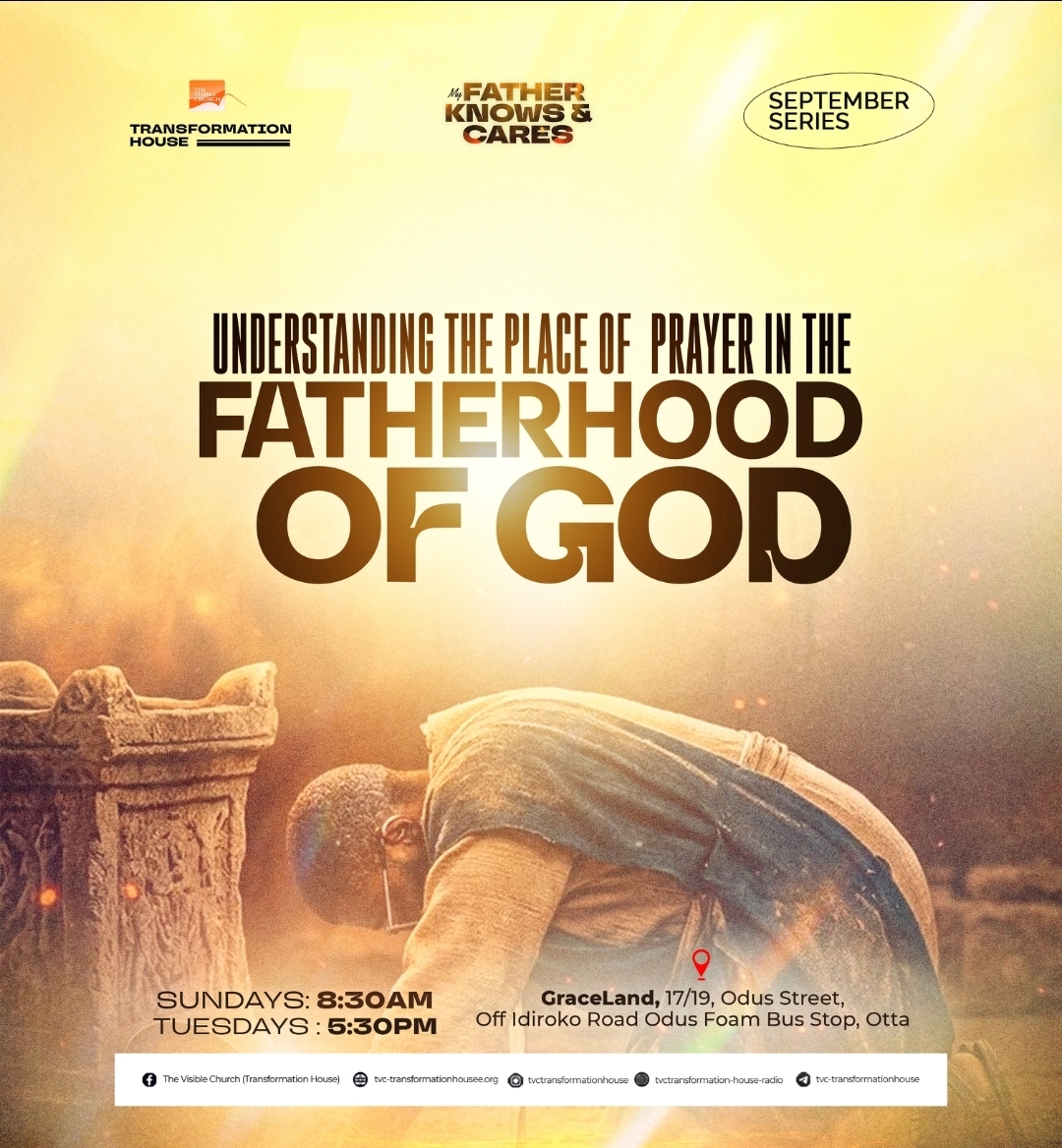
Understanding the Place of Prayer in the Fatherhood of God
Continuing under our monthly theme, “My Father Knows and Cares,” we examine a vital aspect of spiritual life: Understanding the Place of Prayer in the Fatherhood of God. Let us examine our anchor scripture for this theme.
Matthew 6:8–13 (KJV)
Be not ye therefore like unto them: for your Father knoweth what things ye have need of, before ye ask him.
After this manner therefore pray ye: Our Father which art in heaven, Hallowed be thy name.
Thy kingdom come. Thy will be done in earth, as it is in heaven.
Give us this day our daily bread.
And forgive us our debts, as we forgive our debtors.
And lead us not into temptation, but deliver us from evil: For thine is the kingdom, and the power, and the glory, for ever. Amen.
The Core Question: Why Pray If the Father Already Knows?
As we examine the theme of understanding the place of prayer in the Fatherhood of God, a foundational question arises: If I know my Father, and my Father cares, and He already knows what I need before I ask, why then do I need to pray? What is the place of prayer, and why should I pray?
Verse 8 explicitly says, "Be not ye therefore like unto them: for your Father knoweth what things ye have need of, before ye ask him." There is no need to imitate those who use vain repetitions, since your Father already knows what you need before you approach Him.
If God knows what I need, if my Father cares, and if Jesus confirmed that He knows my needs before I even draw near, why do I need to bother praying? Would praying not be a waste of time? This very thought has affected many believers and hindered their prayer lives.
Prayer is not informing the Father about what He does not know. Prayer is fellowship with the Father, prayer is dependence upon Him, prayer is alignment with His will, and prayer is participation in His purpose.
If prayer were merely about informing God of our needs, then Matthew 6:8 would render prayer redundant. But because prayer is vastly bigger than informing God about our needs, Matthew 6:8 becomes a glorious revelation.
Foundations of the Fatherhood of God
Before we come to prayer, our priority must be an understanding of the Fatherhood of God. We are called to trust God even when we cannot trace Him.
Psalms 13:5 (KJV)
But I have trusted in thy mercy; my heart shall rejoice in thy salvation.
Even when we do not understand what is happening, and even when it seems as though we are only seeing the back of His head rather than His face, we trust in His mercy.
Furthermore, the character of God the Father is fully revealed in Jesus Christ. Jesus is the express image of the Father.
Hebrews 1:3 (KJV)
Who being the brightness of his glory, and the express image of his person, and upholding all things by the word of his power, when he had by himself purged our sins, sat down on the right hand of the Majesty on high.
In the original Greek text, the term translated as “express image” is charaktēr (χαρακτήρ, Strong’s G5481), meaning an exact representation, character, and stamp. Jesus displays the precise character of the Father. When religious accusers brought the woman caught in adultery demanding she be stoned according to the Law of Moses, Jesus demonstrated the Father’s heart—a Father who is not willing that any should perish, but that all should come to repentance. Therefore, to know the Father, we do not need special visions; we look at Christ in the Word.
Isaiah 65:24 (KJV)
And it shall come to pass, that before they call, I will answer; and while they are yet speaking, I will hear.
Psalms 139:3–6 (KJV)
Thou compassest my path and my lying down, and art acquainted with all my ways.
For there is not a word in my tongue, but, lo, O LORD, thou knowest it altogether.
Thou hast beset me behind and before, and laid thine hand upon me.
Such knowledge is too wonderful for me; it is high, I cannot attain unto it.
God is so intimately aware of us that before a sentence is formed on our tongue, He knows it completely. He goes into our future to prepare the way and protects us behind. Prayer does not inform God, because God already knows. Yet, Jesus noted, "before ye ask him." This proves that the Father’s prior knowledge does not eliminate asking—it empowers us to pray with absolute confidence!
The Fourfold Place of Prayer
Pillar 1: Prayer is Fellowship with the Father
When Jesus taught His disciples to pray, He began with: "Our Father which art in heaven…" Before He mentioned any physical need, He established the person to whom we come. Prayer is first and foremost a relationship before it is a transaction.
John 17:3 (KJV)
And this is life eternal, that they might know thee the only true God, and Jesus Christ, whom thou hast sent.
1 Peter 3:18 (KJV)
For Christ also hath once suffered for sins, the just for the unjust, that he might bring us to God, being put to death in the flesh, but quickened by the Spirit.
Christ died to bring us to God so that we might know Him, not merely to receive material items. Prayer is one of the primary ways we exercise the access we have received through Christ. In prayer, we commune, listen, submit, worship, and align our hearts with God. Worship is taking what God has declared in His Word and declaring it back to Him in agreement—affirming that we are the righteousness of God in Christ, adopted, accepted, and saved by grace.
James 1:6–7 (KJV)
But let him ask in faith, nothing wavering. For he that wavereth is like a wave of the sea driven with the wind and tossed.
For let not that man think that he shall receive any thing of the Lord.
Pillar 2: Prayer is Dependence upon the Father
Matthew 6:11 (KJV)
Give us this day our daily bread.
Asking for daily bread is not informing God of our physical need; it is an open expression of our total dependence upon Him.
2 Chronicles 20:12 (KJV)
O our God, wilt thou not judge them? For we have no might against this great company that cometh against us; neither know we what to do: but our eyes are upon thee.
When King Jehoshaphat faced overwhelming enemies, he prayed declaring their powerlessness and setting their eyes solely upon God. That is the heart of prayer: expressing total reliance upon the Father.
James 1:17 (KJV)
Every good gift and every perfect gift is from above, and cometh down from the Father of lights, with whom is no variableness, neither shadow of turning.
1 Corinthians 3:6–7 (KJV)
I have planted, Apollos watered; but God gave the increase.
So then neither is he that planteth any thing, neither he that watereth; but God that giveth the increase.
While we must labor, plan, prepare, and make responsible choices, we recognize that human effort alone cannot guarantee increase. Ultimately, all durable results are granted by God.
Pillar 3: Prayer Brings Our Will into Alignment with God’s Will
Matthew 6:10 (KJV)
Thy kingdom come. Thy will be done in earth, as it is in heaven.
Matthew 26:39 (KJV)
And he went a little further, and fell on his face, and prayed, saying, O my Father, if it be possible, let this cup pass from me: nevertheless not as I will, but as thou wilt.
In the Garden of Gethsemane, Jesus demonstrated that prayer is the place where human desires are surrendered to divine purpose. We do not pray to force our will upon God; we pray for our will to align with His.
1 John 5:14 (KJV)
And this is the confidence that we have in him, that, if we ask any thing according to his will, he heareth us.
Jeremiah 29:11–13 (KJV)
For I know the thoughts that I think toward you, saith the LORD, thoughts of peace, and not of evil, to give you an expected end.
Then shall ye call upon me, and ye shall go and pray unto me, and I will hearken unto you.
And ye shall seek me, and find me, when ye shall search for me with all your heart.
Romans 8:26–27 (KJV)
Likewise the Spirit also helpeth our infirmities: for we know not what we should pray for as we ought: but the Spirit itself maketh intercession for us with groanings which cannot be uttered.
And he that searcheth the hearts knoweth what is the mind of the Spirit, because he maketh intercession for the saints according to the will of God.
Our confidence in prayer rests not on demanding our personal preferences, but on seeking and asking according to His revealed will.
Pillar 4: Prayer is Participation in God’s Purpose
Matthew 6:33 (KJV)
But seek ye first the kingdom of God, and his righteousness; and all these things shall be added unto you.
As we mature from spiritual childhood into responsible sonship, we take on the Father’s interests. A loving father does not merely feed his children; he brings them into his business.
2 Corinthians 5:17–20 (KJV)
Therefore if any man be in Christ, he is a new creature: old things are passed away; behold, all things are become new.
And all things are of God, who hath reconciled us to himself by Jesus Christ, and hath given to us the ministry of reconciliation;
To wit, that God was in Christ, reconciling the world unto himself, not imputing their trespasses unto them; and hath committed unto us the word of reconciliation.
Now then we are ambassadors for Christ, as though God did beseech you by us: we pray you in Christ’s stead, be ye reconciled to God.
The paramount desire of the Father is that all men be saved and come to the knowledge of the truth. Through prayer and evangelism, we participate directly in the Father’s eternal mission on earth.
Conclusion and Call to Prayer
My Father knows what I need before I ask Him. Therefore, when I pray:
1. I am fellowshipping with Him.
2. I am showing my dependence upon Him.
3. I am aligning my will to His will.
4. I am participating in His purpose for the earth and for myself.
Let us yield our hearts to the Holy
Spirit, praying in tongues so that our prayers align perfectly with the mind and will of the Father.